Note: This is part 4 (final part) of the discussion of electrical safety. If you have not read part 1, please click here to go to part 1.
Micro shock
Some people get confused by macro shock and micro shock. Let me clarify things for you.
Electric shock can be subdivided into macro shock and micro shock.
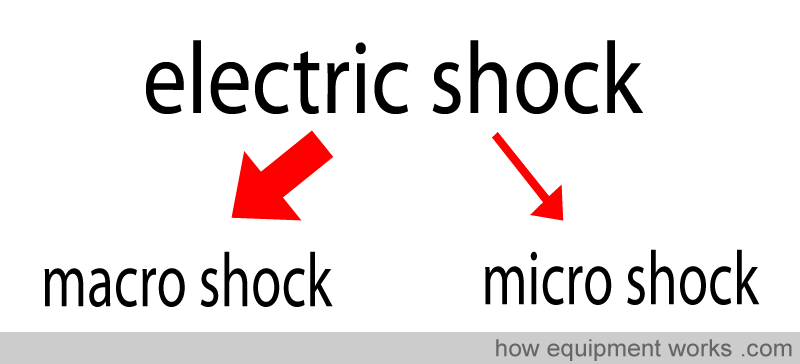
The two main harmful effects of electric shock are burns and ventricular fibrillation. While both can be fatal, when we talk about macro shock versus micro shock, we generally are referring to the risk of ventricular fibrillation.
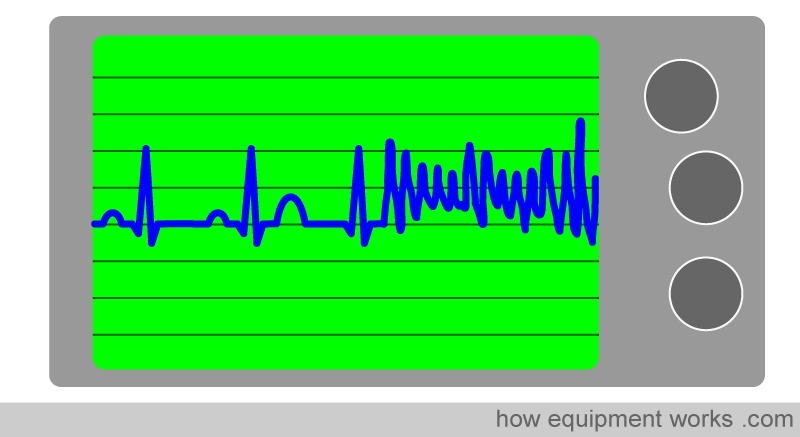
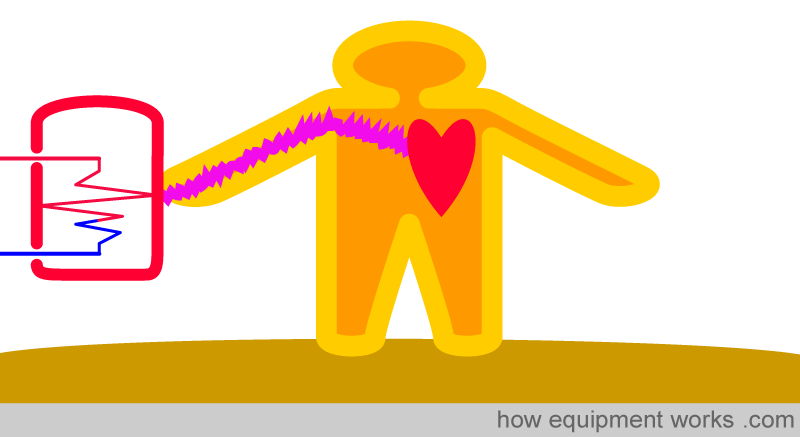
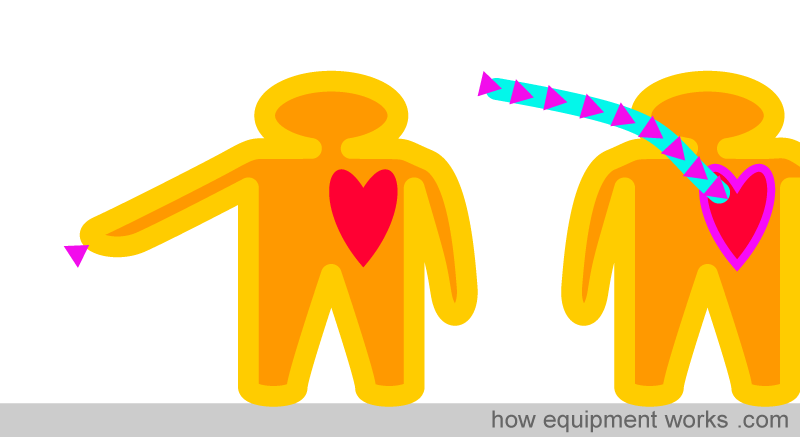
Ventricular fibrillation (VF) causing current can reach the heart in two ways. One route it can take is to go through the skin and tissues to reach the heart.
The other way is to give current straight to the heart without it having to go through the skin and tissues.
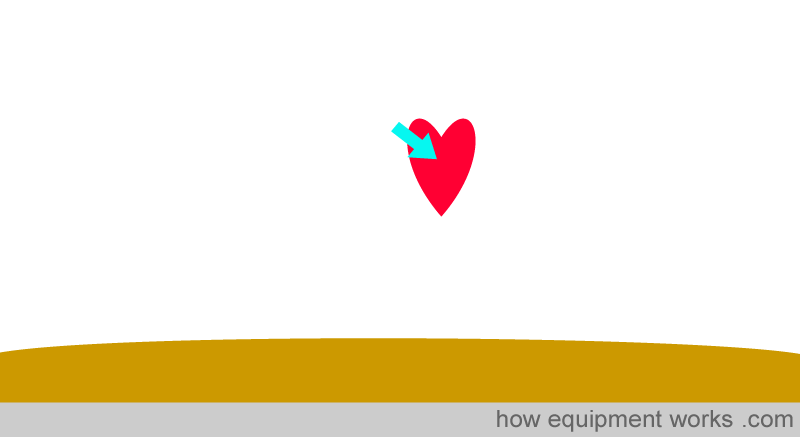
However, most normal human beings don’t carry their heart like a handbag where it could get a direct shock.

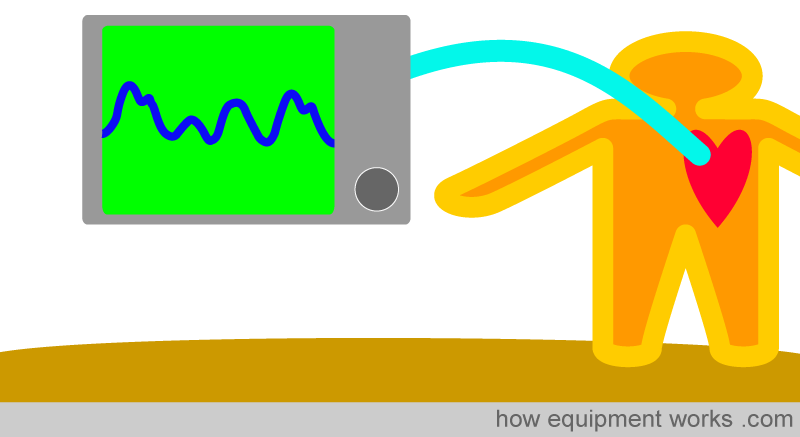
Instead, a shock may be given directly to the heart by something that conducts electricity very well, such as a pacemaker wire or a conducting fluid-filled tube such as a central venous pressure (CVP) catheter.
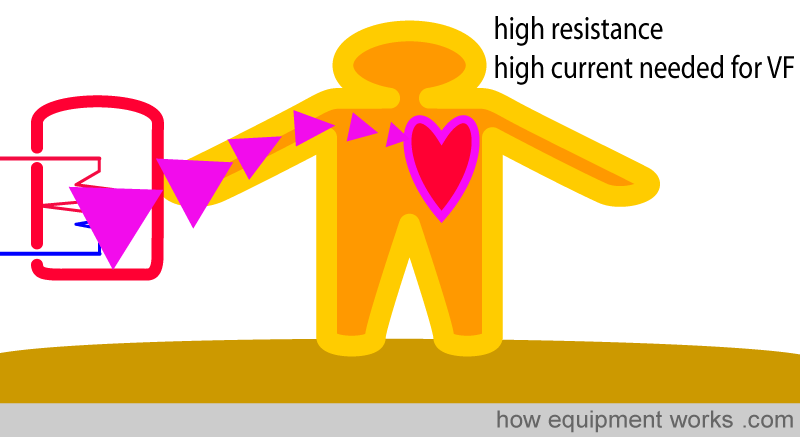
It is important to recognise that there is one big difference in the two routes described. The skin normally has a very high resistance to current flow. Therefore, for “enough “ current to reach the heart and cause ventricular fibrillation (VF), the current given to the skin has to be fairly large.
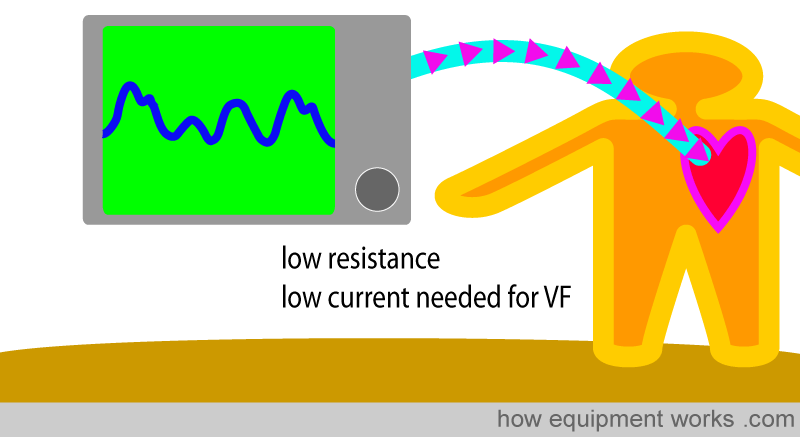
On the other hand, the shock current (pink arrows) that goes straight to the heart does not have to go through the high resistance of the skin. Instead, there is a low-resistance pathway straight to the heart. Because the resistance is low, only a small current is needed to cause VF.
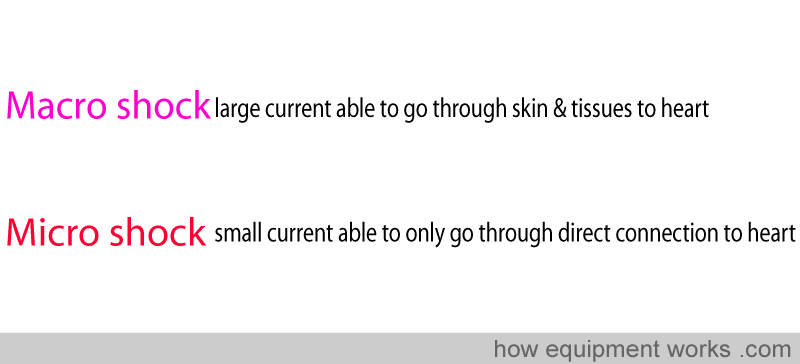
Macro shock is what most people refer to when they say “electric shock “. It is a shock that is large enough to go through the skin and tissues to reach the heart and cause VF. Of course, if applied directly to the heart, it will also cause VF.
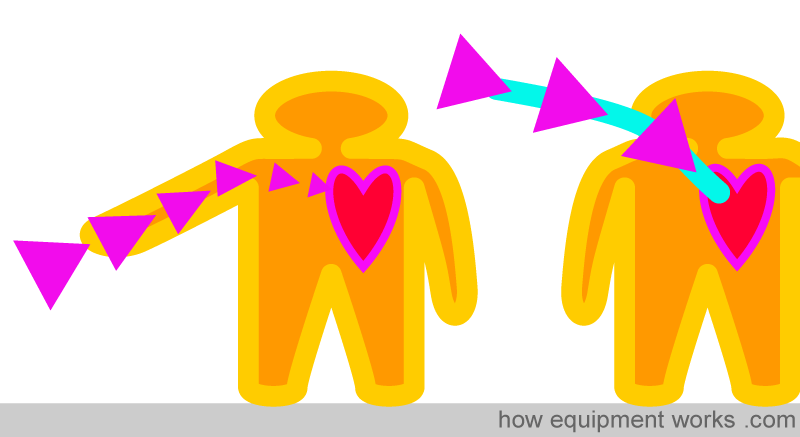
Microshock is different. Micro shock is NOT large enough to go through skin and tissue to reach the heart and cause VF. It however is large enough to cause VF if applied straight onto the heart. Micro shock involves very low currents such as 10 microamperes (i.e. 0.00001 amperes).
I hope this helps you to remember things:
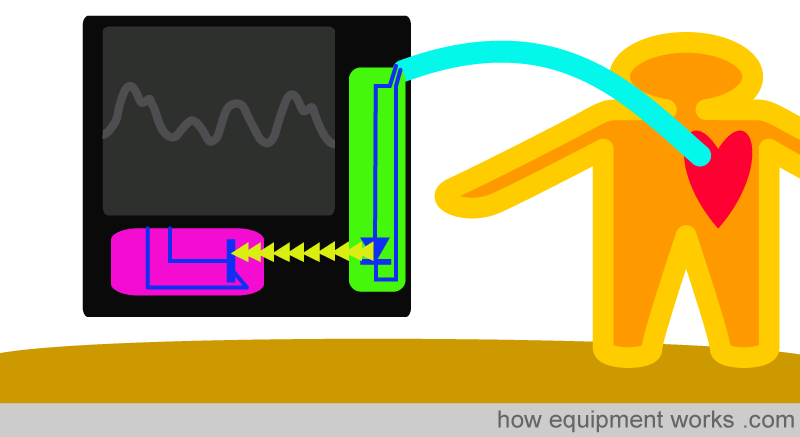
If equipment is expected to come into direct contact with the heart (e.g. external pacemakers, central venous pressure catheters) extreme precautions need to be taken to prevent microshock. These are highly technical design features that are beyond the scope of this website to discuss. For example, inside such equipment, circuits connected to the patient’s heart (green box) may use beams of light (yellow arrows) to communicate with other circuits that are not in direct connection with the heart (pink box). In that way, electrical shocks cannot pass from the red area to the green area. This type of arrangement protects the patient from even microshock currents.

Do you work in the anaesthetic team? If you do, please visit the free website below, which has anaesthesia-related fun and safety material. Click the button below to visit.

Safety Classifications
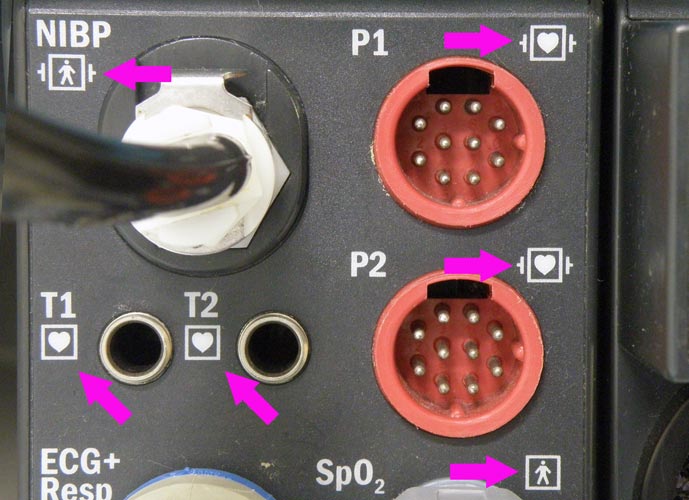
We have so far discussed a variety of safety protections. Safety protections can be classified in a variety of ways. You have already learnt some of these, but let me put common ones here in one place so that you will get a clearer picture. Please note that electrical safety is an area full of complex laws and regulations, so don’t use this stuff in the “real world”. You will often see symbols (see pink arrows) on medical equipment that may tell you what classification it belongs to.
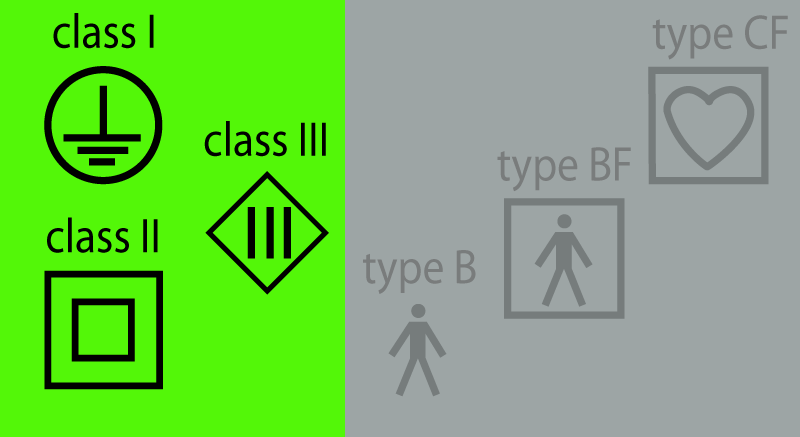
There are two classifications that you might want to know about. One consists of three “classes” (green area below) and the other consists of three “types” (blue area).
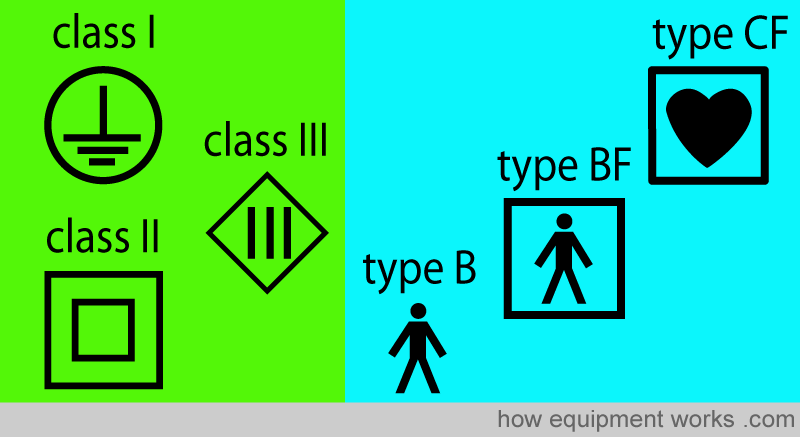
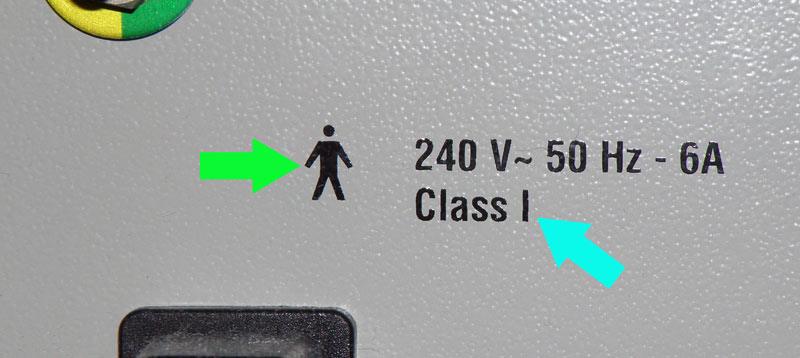
These classifications will be explained to you. Please keep in mind that these are two different classification systems. A piece of equipment can have a classification in both categories at the same time. For example, I took the picture below of an anaesthesia machine. Note that the markings on it tell us that it belongs to “Class I” (blue arrow) and also belongs to “Type B” (green arrow). Both the classification systems will be explained to you briefly.
Let us now briefly go through the classifications. First, we will talk about the “class system”.
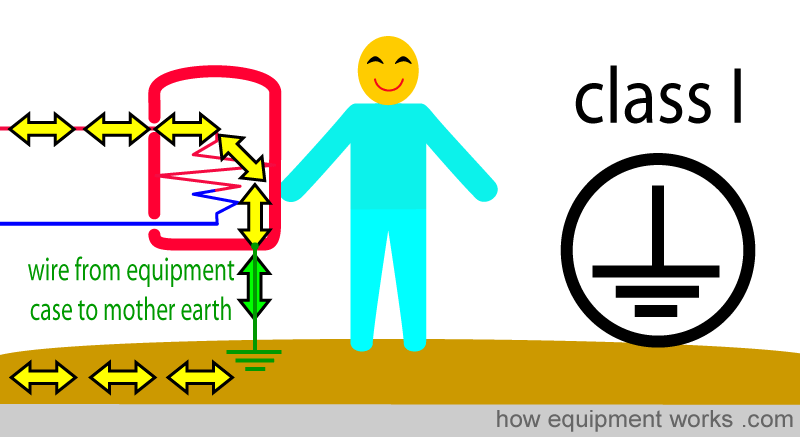
Class I: Equipment in this class makes use of the wire from the equipment case to Mother Earth to provide protection.
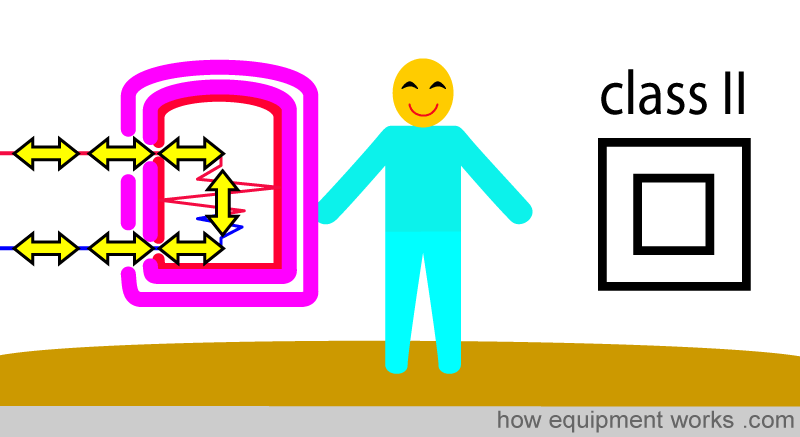
Class II equipment relies on at least two layers of insulation to provide protection.
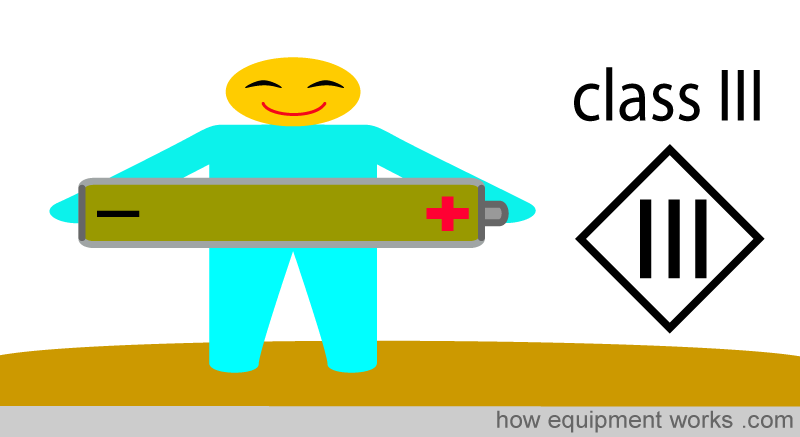
Class III equipment uses low voltages provided by batteries or special power supplies to be “safe”. Lower voltages are considered to be safer than high voltages.
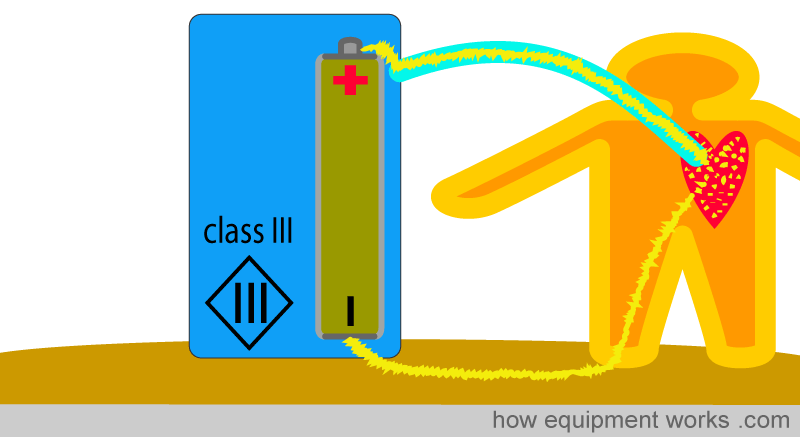
It is important to note that while class III equipment uses low voltages, that itself does NOT make them completely safe for medical use. For example, if a class III piece of equipment has a fault, its low voltages can easily cause microshock if applied directly to the heart.
Now let us discuss the other classification. Do remember that these two classifications are completely different to each other.

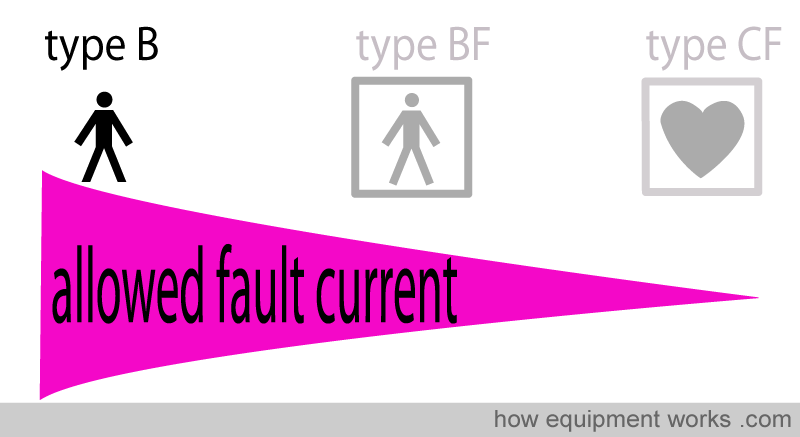
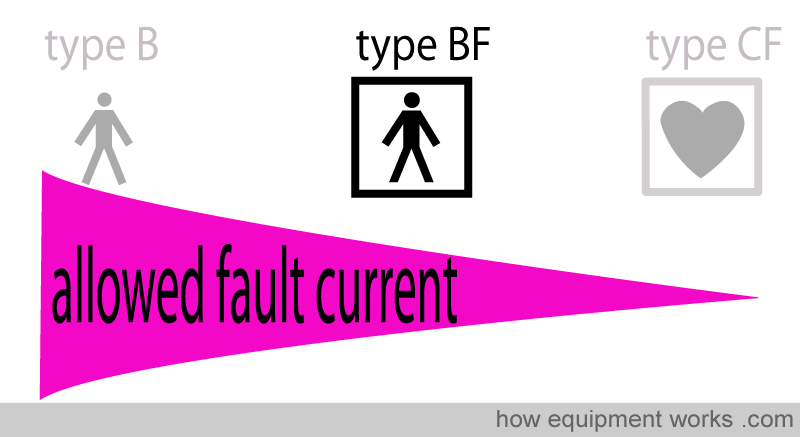
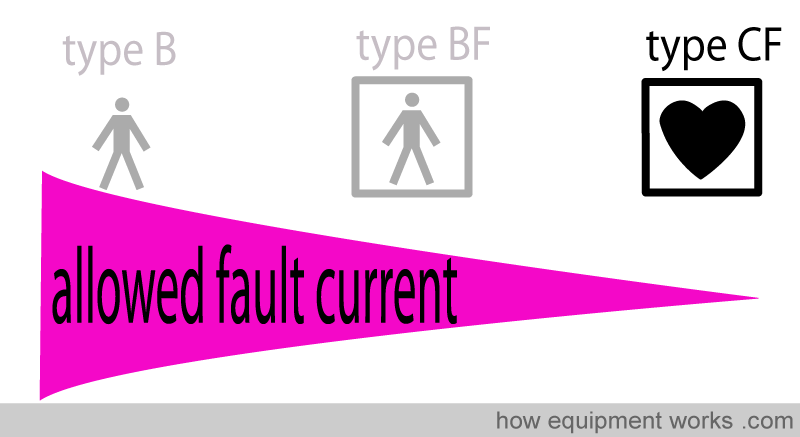
This classification describes how much shock current is allowed to come into contact with the patient or operator if a fault happens. Type B protection allows the most amount of shock current and type CF is the most strict, allowing very little shock current.
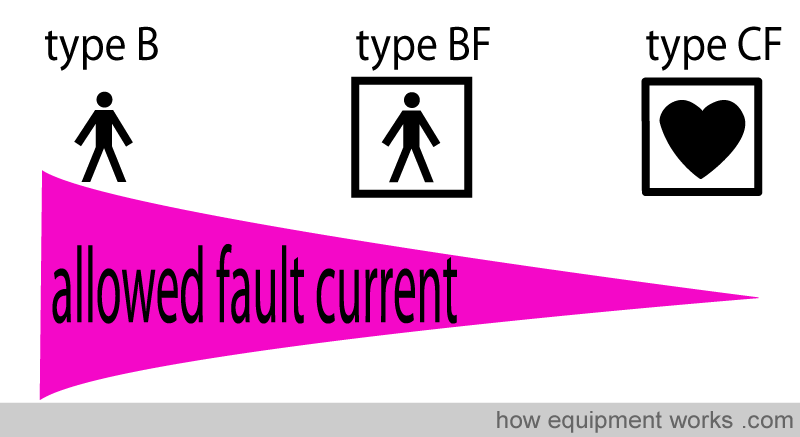
Type B (Body) protection:
This is the least stringent level of protection.
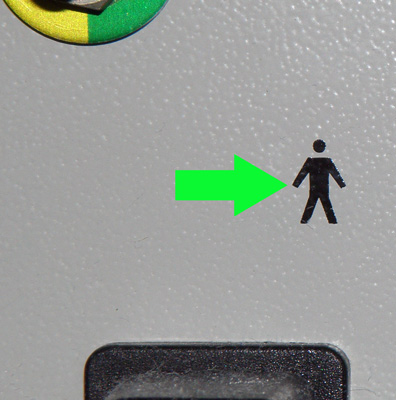
For example, the metal surface of the anaesthetic machine may have this level of protection. Below is a picture of an anaesthetic machine surface showing the symbol for type B protection.
Type BF (Body Floating) protection: This level of protection is more stringent than type B protection and is shown by the “man in the box” symbol below.
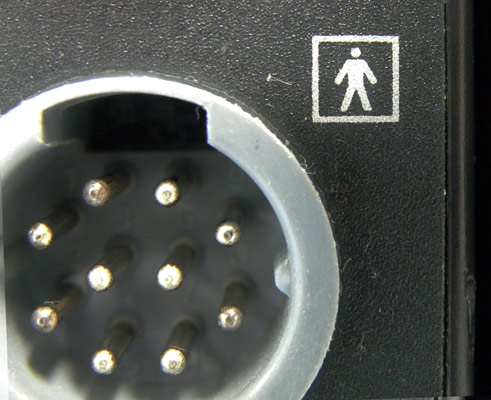
Below is a picture of a plug into which a pulse oximeter probe would normally be connected to. You can see from the symbol next to the plug that it has type BF ( Body Floating ) protection.
Type CF (Cardiac Floating) protection:
This is the most strict level of protection. Under fault conditions, it allows the least amount of shock current to enter the patient.
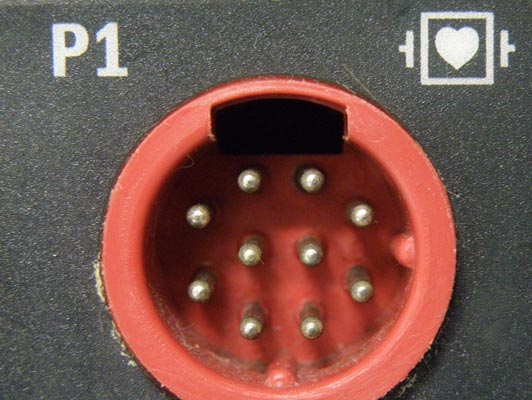
Below is a plug socket where one would plug in a central venous pressure (CVP) monitor. As you read before, a CVP catheter poses a threat of micro shock to the heart. Therefore, as you can see from the symbol (“heart in the box”), this plug has the highest level of protection, i.e.Type CF (Cardiac Floating) protection.
If you look at the symbol above, it has two “ears” on either side. I have shown them in red below.
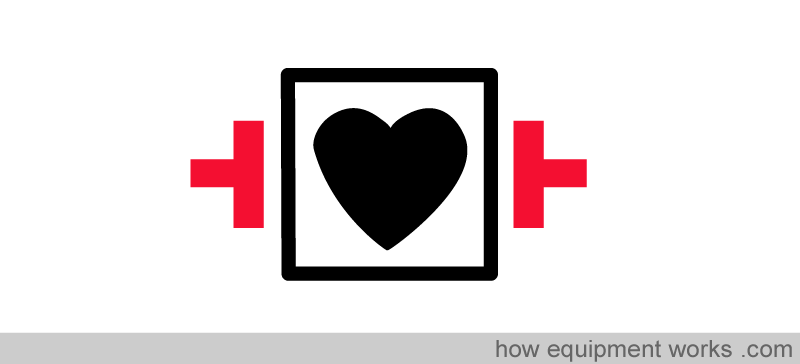
The “ears” on either side symbolise defibrillator pads. Defibrillation generates a very large current. The markings on the symbol indicate that the monitoring equipment can survive the shock of defibrillation.

Effects of electric shock
The effect of electric shock depends on the amount of current that flows through the victim. As the current increases, so does the degree of potential damage. Some of the effects are as follows.
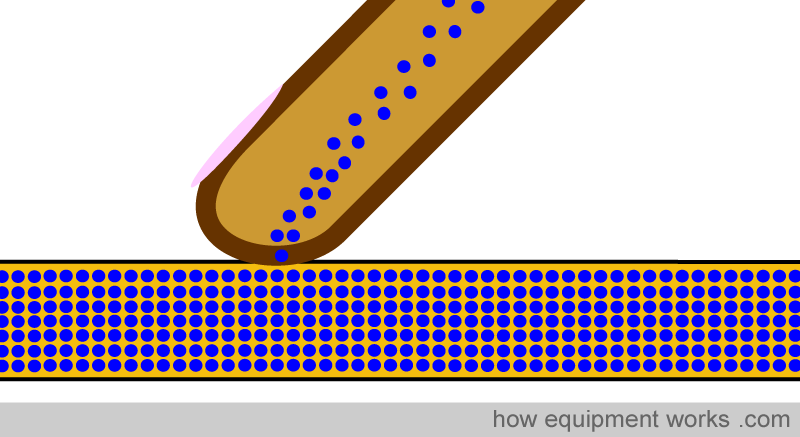
1. Tingling:
This is a “fuzzy “ feeling felt when in contact with an electric current. Even if you find it pleasant (hope you don’t), remove your body immediately, for the pleasantness may soon become unpleasantly fatal.
2. Pain :
This of course is a good thing because hopefully, you will move your body away from the source of the shock. In my case of electric shock described in the beginning, it was pain that made me move my arm away and save my life.

3. Muscle immobility :
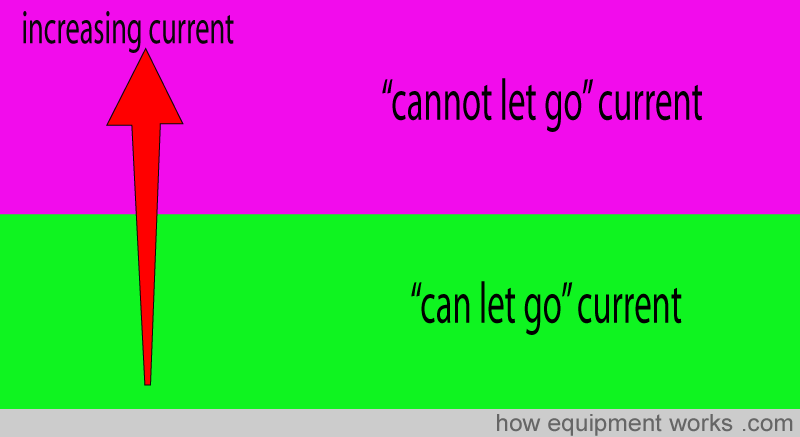
If the electric current is strong enough to immobilise one’s muscles, it becomes difficult to move away from the source of the shock. This is very dangerous because the victim cannot protect him or herself. The level of current that immobilizes the muscles can be called the “cannot let go “ current.
4. Burns:
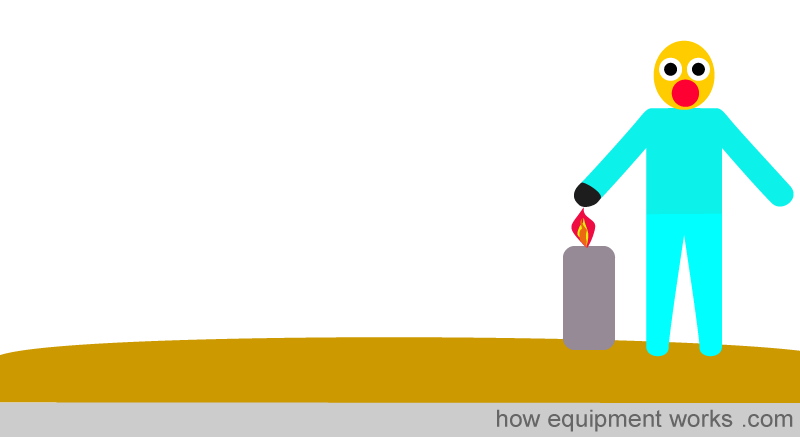
A high current flow can cause electrical burns. This can be worse than burns due to fire. In a fire burn, it is generally the areas directly exposed to the fire that burn.
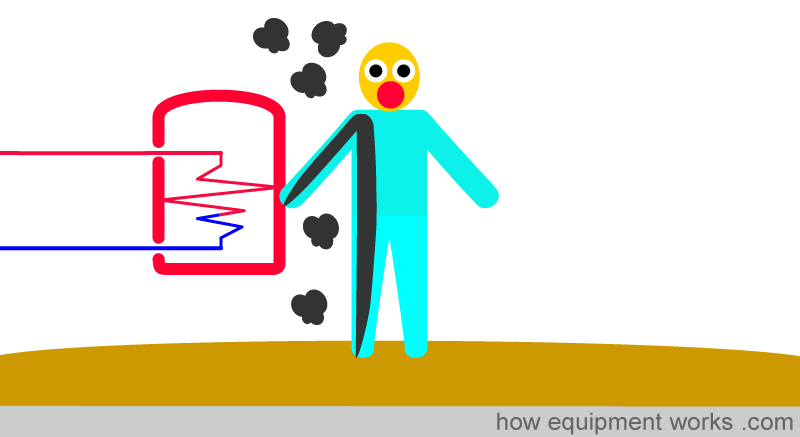
With electrical burns, as the current travels inside the body, it burns tissues along the path. This can result in burns that may look minor from the outside while being deeply damaging inside.
5. Ventricular fibrillation:
The heart itself uses electricity to communicate in an orderly manner. It is the organised passage of electrical signals that make the atria and ventricles contract effectively to provide a cardiac output. Electrical shock can disrupt this orderly passage of the heart’s own current. This may result in ventricular fibrillation, which if not treated, will be fatal.
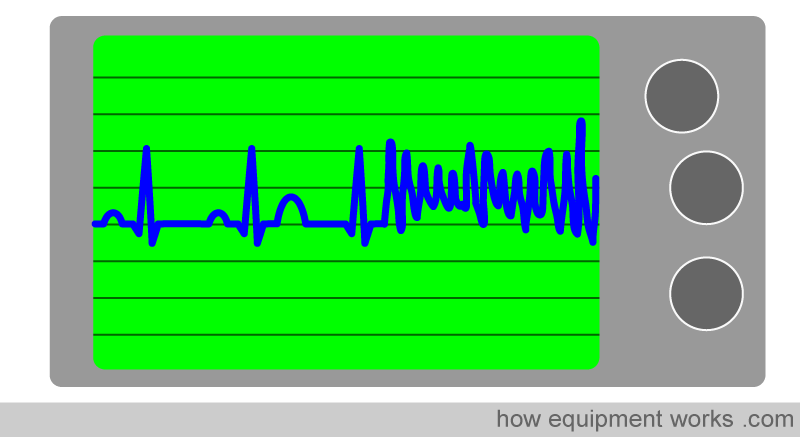
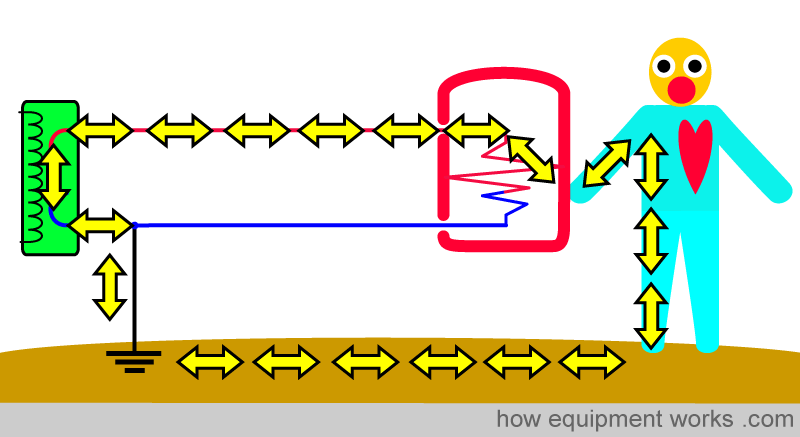
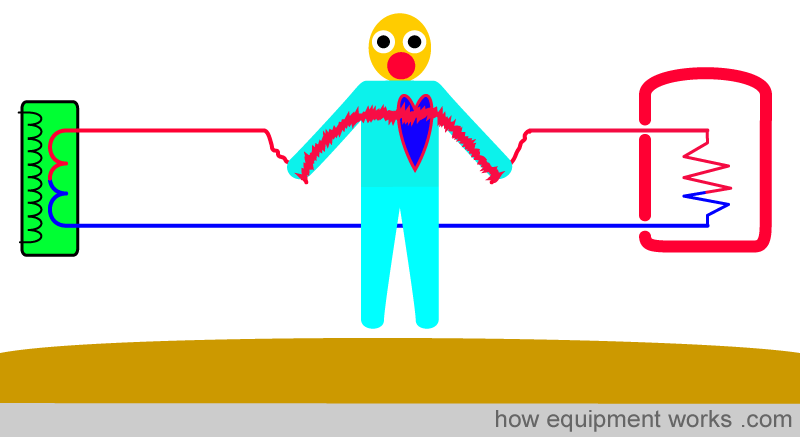
The likelihood of the electric shock to cause ventricular fibrillation depends on many factors. For example, the path that the current takes in the body influences the likelihood of fibrillation. In the example below, most of the current is not going through the heart, which is therefore less affected.
However, in the example below, the current is going right across the heart, increasing the risk of ventricular fibrillation.
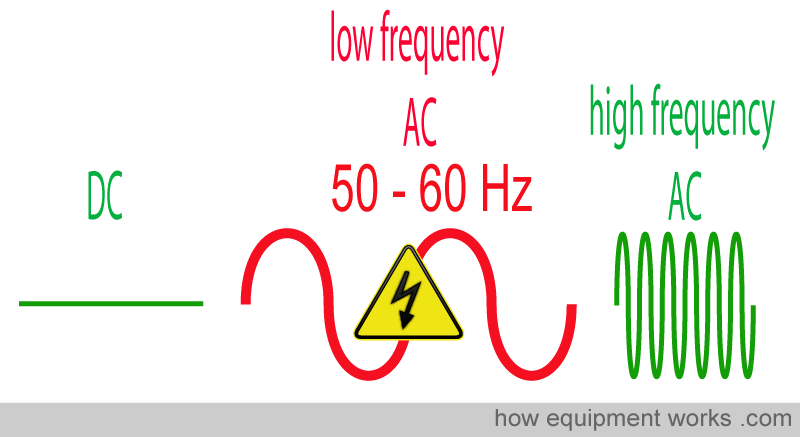
The risk of ventricular fibrillation also depends on the frequency of current. Low-frequency alternating current (AC), such as what typically comes out of a household or hospital power socket is the worst. Direct current (DC) (e.g. from batteries) and high-frequency AC (e.g. from electrosurgical / diathermy machines) is safer.
( If DC or AC doesn’t make sense, please read the “basic electrical concepts” part of this website).
What can you do for safety?
Some things you can do:
Visually inspect equipment for damage
Visually inspect wires for damage. Avoid subjecting them to physical stresses such as rolling equipment over them or pulling on them
Report any unusual sensations promptly.
Keep equipment dry unless they are specifically designed to be wet.
Wear appropriately insulated shoes.
Make sure your hospital engineering department does regular inspections.
Do not try to repair things yourself. A little knowledge can be a dangerous thing.
Make contingency plans for power failure.
Most importantly, if you suspect a fault, report it immediately to your engineering department. Never assume that “someone else” will do it.

How electricity saved me!
At the beginning, I mentioned how electricity nearly killed me. But electricity has also been kind to me as it once saved my life. It all happened during a very important anaesthesia oral examination. I was answering the questions well.
The exam was getting better and better……
And then disaster struck. I was asked a question that I just didn’t know the answer.
I was really stuck. It was something I just hadn’t read. And then, electricity helped me. There was a power failure ! Everything went dark.

Within a few minutes, the electricity supply came back. But by then, the examiner had forgotten the tough question. I passed the exam thanks to electricity helping me out!
Summary
Electricity can be dangerous, especially in the operating room, because there is so much electrical equipment around, anaesthetised patients cannot move away from danger, electric current is invisible, and there are fluids everywhere which can increase the risk of shock.
To get a shock, the person must be part of a circuit. The basic shock pathway helps us to understand this.
Insulation can prevent shock.
The earth wire (wire from equipment casing to Mother Earth) prevents shock by diverting current and also stopping the current flow by triggering devices that stop high current flow (e.g. fuses, circuit breakers)
Devices that shut off current by detecting differences in outgoing and returning current can protect even small current shocks. (e.g. residual current device, RCD)
Isolation transformers can protect a person by isolating one part of the circuit from another. The isolation transformer does not have a wire from neutral to Mother Earth and therefore does not provide a path for the shock current to return.
Electric shock can be classified as a macro-shock or micro-shock. If the patient is at risk of developing micro-shock (e.g. when using pacemaker wires or central venous monitoring), equipment designed to prevent micro-shock should be used.
Briefly discussed the physical effects of shock.
There are classifications that tell us about the nature of protection against electric shock a device has. Two such classifications, along with their symbols were discussed.
We have now reached the end of our discussion on electrical safety. I hope it has given you a good introduction to the subject and will help you when you read further on this topic. Hope to see you soon in another section. Bye for now.

Hello! My name is Pras, and I am the author of this website. I have made the website completely free to access so that people from all over the world can benefit from it.
If you can afford it, I would be very grateful if you would consider making a single donation of one dollar (or the equivalent in your currency) to help cover the expenses needed to run this website (e.g. for special software and computers). For this website to survive, donations are desperately needed. Sadly, without donations, this website may have to be closed down.
Unfortunately, perhaps because many people think that someone else will donate, this website gets only very few donations. If you are able to, please consider making a single donation equivalent to one dollar. With support from people like you, I am sure this educational website will continue to survive and grow. Thank you very much for your support.